
Video Wall Viewing Distance Guide
Viewing distance is one of the most important factors in selecting the correct LED video wall for an event.
The distance between the audience and the display affects pixel pitch, screen size, text readability, image detail, camera visibility, presentation design, and overall viewing comfort.
This Video Wall Viewing Distance Guide answers the most common questions about how close or far an audience should be from an LED video wall.
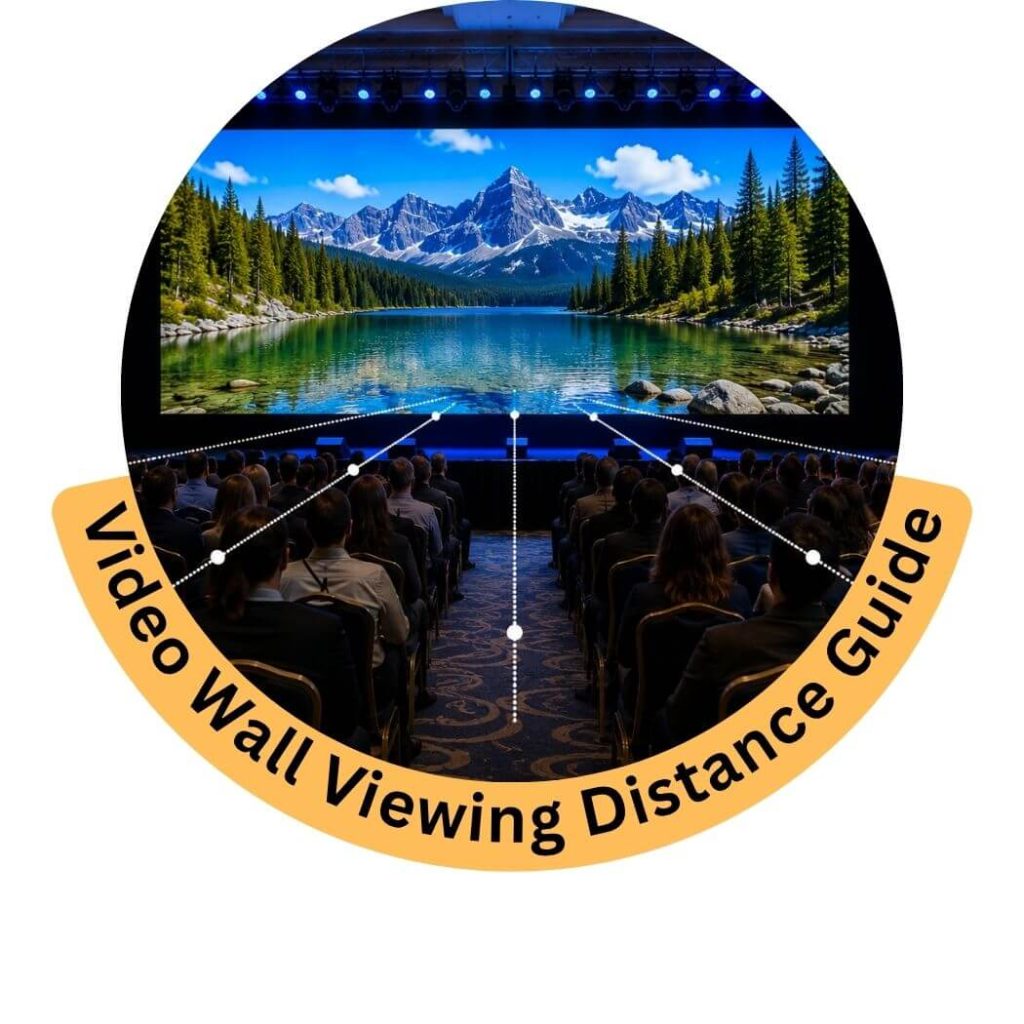
Frequently Asked Questions About Video Wall Viewing Distance
What is video wall viewing distance?
Video wall viewing distance is the physical distance between the audience and the LED display.
For event planning, we normally consider both:
Closest viewing distance
Farthest viewing distance
Both measurements matter because the nearest attendee affects pixel-pitch selection while the farthest attendee affects screen size and content readability.
Why is viewing distance important for an LED video wall?
Viewing distance helps determine whether attendees can comfortably see:
Presentation text
Charts
Graphics
Videos
Speaker names
Camera IMAG
Data
Sponsor content
It also helps determine the appropriate pixel pitch and physical screen dimensions.
What is the closest viewing distance?
The closest viewing distance is the distance between the LED wall and the nearest audience member who is expected to view the screen normally.
This measurement is particularly important when choosing pixel pitch.
What is the farthest viewing distance?
The farthest viewing distance is the distance between the LED wall and the most distant audience members.
It helps determine whether the physical screen dimensions are large enough for content and live cameras to remain useful throughout the room or event site.
Which matters more: closest or farthest viewing distance?
Both matter, but for different reasons.
The closest viewing distance strongly influences pixel-pitch selection.
The farthest viewing distance strongly influences screen size, content scale, and whether supplemental screens or IMAG are needed.
How does pixel pitch affect viewing distance?
Pixel pitch describes the distance between adjacent LED pixels.
A smaller pixel pitch creates greater pixel density and generally provides smoother image detail at shorter viewing distances.
A larger pixel pitch is often suitable where audiences are farther from the screen.
Does smaller pixel pitch mean people can sit closer?
Generally, yes.
Fine-pitch LED makes individual pixels less noticeable at close viewing distances.
This is why fine-pitch LED is commonly used for:
Corporate meetings
Conferences
Medical events
Research presentations
Trade shows
Executive events
Close audience seating
Is the smallest pixel pitch always best?
No.
Using a pixel pitch significantly finer than the audience actually needs can increase equipment cost without providing a meaningful viewing benefit.
Pixel pitch should be matched to the real audience distance.
What pixel pitch should I use for close viewing?
Close-view events generally benefit from finer-pitch LED.
The exact choice depends on:
Closest audience distance
Content detail
Screen dimensions
Budget
Camera requirements
Venue layout
Detailed presentation environments usually require more attention to pixel density than long-distance entertainment viewing.
What pixel pitch should I use for longer viewing distances?
Larger-pitch LED can be appropriate when the audience is farther away.
This is common for:
Outdoor events
Concerts
Festivals
Graduations
Sporting events
Fan zones
Large public programs
At longer distances, individual pixels become much less noticeable.
Is there a simple pixel-pitch viewing-distance rule?
You may see simplified rules that compare the pixel-pitch number in millimeters with an approximate viewing distance in meters.
These can be useful as a rough starting point, but they should not replace actual event planning.
Content detail, audience expectations, screen dimensions, and camera use also matter.
Can I choose pixel pitch using only a formula?
Not reliably.
A formula can provide an initial reference, but the correct system should also consider:
Presentation detail
Font size
Screen dimensions
Audience depth
Budget
Camera requirements
Content type
What happens if the audience sits too close to the LED wall?
If viewers are too close to a larger-pitch LED wall, they may notice:
Individual pixels
Pixel structure
Reduced image smoothness
Less comfortable viewing of detailed content
A finer-pitch display may be more appropriate.
What happens if the audience is too far from the LED wall?
The image itself may remain visible, but important details can become too small.
Attendees may struggle to read:
Slide text
Charts
Tables
Speaker names
Captions
Data
Small graphics
In these cases, a larger screen or supplemental displays may be required.
Can a video wall be visible from very far away?
Yes.
Large LED displays can remain visually noticeable from significant distances.
However, being able to see the screen is different from being able to read detailed content on it.
What is the difference between visibility distance and readable distance?
Visibility distance means the audience can see that content is appearing on the screen.
Readable distance means attendees can comfortably understand the text, charts, graphics, or other details.
Readable distance is usually much shorter than basic visibility distance.
How far away can attendees read PowerPoint slides?
There is no fixed distance.
Readability depends on:
Screen dimensions
Font size
Slide design
Contrast
Pixel pitch
Screen elevation
Audience eyesight
Room depth
Presentation content should be designed for the farthest intended viewer.
Does PowerPoint require a shorter viewing distance than video?
Usually, yes.
Full-screen video can often be understood from farther away than slides containing:
Small text
Tables
Charts
Multiple bullet points
Detailed graphics
Presentation-heavy events require more careful planning.
How does font size affect viewing distance?
Larger text can be read from farther away.
Small fonts may be technically sharp on the LED wall but still unreadable for the rear audience because of physical viewing distance.
Can a high-resolution LED wall make small text readable from farther away?
Only to a point.
Higher resolution improves image detail, but it cannot overcome text that is physically too small for the viewer’s distance.
Screen size and content design remain important.
Does screen size affect viewing distance?
Yes.
Larger physical screens allow content and camera images to appear larger to distant viewers.
Increasing screen dimensions can improve visibility for deeper audiences.
Does a larger screen always allow farther viewing?
Generally, larger screens improve long-distance visibility, but the content must also use the additional screen area effectively.
A very large screen showing tiny text can still be difficult to read.
Does viewing distance determine video wall size?
It is one of the major factors.
For deep rooms or large outdoor audiences, the screen may need to be larger to remain useful for attendees at the back.
Does viewing distance determine pixel pitch?
It strongly influences pixel pitch, particularly the closest viewing distance.
Fine-pitch LED is commonly selected where attendees sit close to the screen.
Should I choose screen size or pixel pitch based on viewing distance?
Both.
A professional configuration should typically:
Review the audience footprint.
Identify closest and farthest viewing distances.
Determine appropriate screen dimensions.
Select a suitable pixel pitch.
Calculate native resolution.
Review the actual content.
How close can attendees sit to a fine-pitch video wall?
That depends on the specific pixel pitch.
Fine-pitch LED is designed for shorter viewing distances than standard large-pitch displays, but the exact comfortable distance depends on the product and content.
Can attendees stand directly in front of an LED wall?
They can view fine-pitch LED at close range in suitable environments, but event layouts should also preserve:
Stage clearances
Structural areas
Cable routes
Equipment access
Audience circulation
What is a comfortable viewing distance for an indoor LED wall?
There is no universal distance.
Indoor viewing distance should be matched to the pixel pitch and content.
A conference audience viewing detailed presentations usually requires a finer screen than an entertainment audience viewing mostly video from the same distance.
What is a comfortable viewing distance for an outdoor LED wall?
Outdoor LED is typically viewed from farther away.
The appropriate distance depends on:
Pixel pitch
Screen size
Screen height
Audience footprint
Content
Event type
Why do outdoor LED walls often use larger pixel pitches?
Outdoor audiences often view screens from much greater distances.
At those distances, the additional pixel density of very fine-pitch LED may provide little visible benefit.
Does daylight affect viewing distance?
Daylight mainly affects brightness and contrast rather than physical viewing distance.
However, poor contrast can make content harder to interpret from farther away.
Does screen brightness improve long-distance visibility?
Adequate brightness improves visibility under bright ambient conditions, but brightness does not make small text physically larger.
Screen size and content scale remain essential.
Does contrast affect viewing distance?
Yes.
Strong contrast between text and background can improve readability, particularly for distant viewers.
Is white text on a dark background easier to read from far away?
It can be, depending on font weight, size, brightness, and overall design.
The most important principle is strong contrast and simple visual hierarchy.
Should presentation slides be redesigned for long viewing distances?
Often, yes.
For large rooms or outdoor events, slides should generally use:
Larger fonts
Fewer words
Strong contrast
Larger charts
Simplified tables
Clear images
Limited small detail
Can detailed spreadsheets be shown on an LED wall?
Yes, but they may be difficult for distant attendees to read.
For large audiences, it may be better to simplify the spreadsheet or highlight only the most important information.
Can medical images be viewed from a video wall?
Yes for event presentation purposes, provided the system is configured appropriately.
However, diagnostic or other regulated clinical viewing requirements should be defined separately by the organizer.
Does research data require a shorter viewing distance?
Detailed research content often does.
Charts, tables, diagrams, and small annotations typically require either:
A larger screen
Larger content
Finer pixel pitch
Shorter viewing distance
What viewing distance is best for corporate presentations?
There is no single distance.
Corporate presentations should be planned around the actual room depth and the smallest content attendees must read.
What viewing distance is best for medical conferences?
Medical conferences often contain detailed diagrams, research data, and text.
Fine-pitch LED and larger presentation layouts can help maintain clarity for both close and distant attendees.
What viewing distance is best for trade shows?
Trade show attendees often stand close to displays.
Fine-pitch LED is commonly useful because booth visitors may view the screen from only a few feet away.
What viewing distance is best for exhibitions?
Exhibition displays should account for both close booth visitors and people viewing from nearby aisles.
The screen and content may need to work at multiple distances.
What viewing distance is best for product launches?
Product launches may combine close audience viewing with larger stage environments.
Screen dimensions and pixel pitch should support both detailed product content and overall visual impact.
What viewing distance is best for galas?
Gala audiences may be spread across round tables, creating long and angled viewing distances.
A larger central LED wall or supplemental side screens may improve visibility.
What viewing distance is best for weddings?
Wedding display requirements depend on room depth, table layout, stage position, and the type of content being shown.
Videos and photography generally tolerate longer viewing distances than detailed presentation text.
What viewing distance is best for award ceremonies?
Award graphics, honoree names, cameras, and sponsor content must remain visible throughout the room.
Screen dimensions should account for the farthest tables.
What viewing distance is best for graduations?
Graduations often involve large audiences and long viewing distances.
Large-format LED and camera IMAG can significantly improve visibility of graduates and speakers.
What viewing distance is best for concerts?
Concert audiences may extend hundreds of feet from the stage.
Large screens and camera IMAG are used to maintain performer visibility at long distances.
What viewing distance is best for sporting events?
Large sports-viewing environments typically require large elevated LED displays designed for long-distance visibility.
What viewing distance is best for fan zones?
Fan zones can have deep standing audiences.
Screen size, elevation, brightness, and viewing angle should all be planned around the audience footprint.
What viewing distance is best for outdoor movies?
The audience should be positioned where the entire screen can be comfortably viewed without excessive head movement while remaining large enough for image detail.
Exact distance depends on screen size.
Can the audience sit too close to a very large LED wall?
Yes.
Even with fine-pitch LED, sitting extremely close to an oversized display may create an uncomfortable field of view where viewers must move their eyes or heads excessively to follow the content.
Is there an ideal viewing angle for an LED wall?
A position near the center of the screen generally provides the most balanced viewing experience.
Modern LED products can provide wide viewing angles, but severe side angles can still reduce perceived image quality and content readability.
Does horizontal viewing angle affect visibility?
Yes.
Attendees seated far to the side may experience:
Distorted perspective
Reduced text readability
Less comfortable viewing
Wide rooms may require supplemental screens.
Does vertical viewing angle matter?
Yes.
A screen mounted too high or too low can become uncomfortable for the audience.
Screen elevation should be matched to seating depth and stage height.
How high should a video wall be for a deep audience?
The bottom of the screen may need to be elevated so attendees farther back can see above people in front of them.
Exact height depends on:
Stage height
Screen size
Audience seating
Room slope
Sightlines
Does standing audience viewing require higher screen placement?
Often, yes.
Standing crowds can block one another’s sightlines, so outdoor and festival screens are commonly elevated.
Does seated audience viewing require less elevation?
Potentially.
Seated audiences may allow a lower screen position, but stage height and room depth still need to be considered.
Can screen elevation compensate for a small screen?
Only partially.
Raising a screen improves sightlines but does not make the content physically larger.
A screen that is too small may still be difficult to read from the rear.
Can a larger screen compensate for a higher pixel pitch?
At longer distances, yes to some extent.
Physical size and viewing distance often matter more than very fine pixel density for large audiences.
Can finer pixel pitch compensate for a small screen?
Not for distant viewers.
Fine pixel pitch improves detail at close range, but it does not enlarge the physical content.
What matters more for rear-row attendees: pixel pitch or screen size?
Usually screen size.
At long viewing distances, physical content size becomes a major limitation.
What matters more for front-row attendees: pixel pitch or screen size?
Pixel pitch becomes more important for front-row viewers because they are close enough to notice pixel structure.
Can one video wall work for both close and far viewers?
Yes, if the system is designed carefully.
This typically requires balancing:
Screen size
Fine-enough pixel pitch
Screen elevation
Content scale
Audience layout
What if the room has both very close and very distant seating?
A hybrid strategy may be required.
Options include:
Fine-pitch main LED
Larger main screen
Supplemental screens
Side screens
Cameras and IMAG
Improved seating layout
When should supplemental screens be added?
Supplemental screens are useful when the main wall cannot provide comfortable visibility for:
Rear seating
Side seating
Overflow rooms
Secondary spaces
Can side screens improve viewing distance?
Yes.
Side screens reduce the effective distance and viewing angle for attendees positioned far from the central display.
When should I use two side screens instead of one central wall?
This can be useful when:
The audience is very wide
The room is deep
The stage has a central scenic feature
Large side seating areas exist
Camera IMAG is important
Can TV monitors improve visibility in smaller secondary areas?
Yes.
TV monitors can provide cost-effective viewing in:
Breakout rooms
Overflow areas
Registration
Green rooms
VIP spaces
What is IMAG and how does it affect viewing distance?
IMAG means image magnification.
Live cameras capture speakers or performers and display them enlarged on the video wall.
This is especially useful when audience members are too far away to see facial expressions or stage details directly.
When does an audience need IMAG?
IMAG becomes useful when the direct view of speakers or performers is insufficient for distant attendees.
Common applications include:
Large conferences
Graduations
Concerts
Award ceremonies
Sporting events
Public events
Does IMAG allow the screen to be smaller?
Not necessarily.
IMAG makes speakers more visible on the screen, but the screen itself still needs to be large enough for the audience to see the camera image.
How large should a speaker’s face appear on the LED wall?
Camera framing should be selected so distant viewers can comfortably see facial expressions.
Large audiences often benefit from tighter shots such as head-and-shoulders or medium framing.
Can presentations and IMAG appear together?
Yes.
Professional processing can create layouts that combine:
Presentation slides
Live cameras
Speaker names
Branding
Remote participants
Does split-screen content reduce readable viewing distance?
It can.
When a screen is divided into multiple windows, each source becomes physically smaller.
This may require a larger overall screen.
Can picture-in-picture affect viewing distance?
Yes.
If the presentation is reduced to make room for a camera feed, text may become harder to read from the rear audience.
Does ultra-wide LED improve viewing for large audiences?
It can.
Ultra-wide displays provide more physical canvas for combining cameras, presentations, graphics, and branding.
However, content design becomes especially important.
Does a curved LED wall affect viewing distance?
A curved screen can improve the visual relationship with wide audiences in some environments, but the design should account for screen radius, viewing angles, and content mapping.
Do vertical LED displays have different viewing-distance requirements?
Yes.
Vertical displays are often better suited to portraits, branding, scenic content, and speaker images than detailed horizontal presentations.
Does content resolution determine viewing distance?
Not by itself.
Resolution affects detail, but physical screen size and audience distance are equally important.
Does 4K content allow farther viewing?
No.
Higher source resolution does not make content physically larger.
A 4K slide with small text can still be unreadable from far away.
Does native LED resolution affect viewing quality?
Yes.
The native resolution determines the actual number of pixels on the LED canvas.
It should be considered together with pixel pitch, physical dimensions, and viewing distance.
Does video scaling affect viewing distance?
Scaling affects image quality but not the fundamental physical visibility of the screen.
A well-scaled image can look cleaner, but distant viewers still require appropriately sized content.
How do I measure closest viewing distance?
Measure from the front surface of the LED wall to the nearest normal audience viewing position.
Do not measure only from the stage edge.
How do I measure farthest viewing distance?
Measure from the LED wall to the most distant audience area that needs to clearly see the display.
Should I measure diagonally or straight from the screen?
For basic planning, measure the practical line-of-sight distance from the display to the audience position.
Wide side seating may also require angle analysis.
Can I estimate viewing distance from a floor plan?
Yes.
Venue floor plans can provide useful measurements for:
Room depth
Audience width
Stage position
Seating areas
Accurate scale drawings are especially helpful.
Can I estimate viewing distance from seating charts?
Yes.
Seating charts can help identify the nearest, farthest, and most extreme side-viewing positions.
Can you determine viewing distance from venue dimensions?
Yes.
If the room dimensions, stage location, and seating plan are known, approximate viewing distances can usually be calculated.
Do I need a site visit to determine viewing distance?
Not always.
Floor plans, measurements, technical drawings, photographs, and seating layouts may provide enough information.
Complex venues may benefit from a site review.
Should viewing distance be checked before choosing LED equipment?
Yes.
Viewing distance should be established early because it influences both pixel pitch and physical screen size.
Should viewing distance be checked before designing content?
Yes.
Content should be created around how far the audience will be from the display.
How can I make content easier to read from far away?
Use:
Larger fonts
Shorter text
Strong contrast
Simpler charts
Fewer data points
Large images
Clear visual hierarchy
Full-screen layouts where possible
What font size should I use on a video wall?
There is no universal font size because final readability depends on screen dimensions and audience distance.
The farther the audience, the larger the displayed text should be.
Should I avoid small subtitles on large event screens?
Generally, yes.
Small captions can be difficult to read from the rear of a large room or outdoor audience.
Should charts be simplified for large audiences?
Yes.
Complex charts should be simplified so the most important information can be understood from the expected viewing distance.
Should tables be avoided on large event screens?
Dense tables are often difficult to read from far away.
If tables are necessary, increase text size and reduce the amount of information shown at one time.
Can QR codes be scanned from a video wall?
Potentially.
QR-code performance depends on:
Code size
Screen resolution
Viewing distance
Camera quality
Brightness
Contrast
Testing is recommended before the event.
Does viewing distance affect QR code size?
Yes.
QR codes must be physically large enough for attendee devices to resolve them from the intended distance.
Does viewing distance affect sponsor logo size?
Yes.
Sponsor logos should be large enough to remain recognizable from the intended audience positions.
Does viewing distance affect lower-third graphics?
Yes.
Speaker names and lower-third graphics should be sized for the farthest expected viewer.
Can live captions be shown on an LED wall?
Yes.
Caption size and placement should be selected based on audience distance and screen layout.
Does viewing distance affect subtitle readability?
Yes.
Subtitles should be significantly larger for event screens than they would be on a personal television or laptop.
What if the audience includes visually impaired attendees?
Accessibility planning should consider larger text, strong contrast, appropriate screen placement, captions, and other event accessibility measures determined by the organizer.
Can multiple screens improve accessibility?
They can improve visual access for attendees who are farther from or poorly aligned with the main screen.
Does viewing distance affect outdoor wayfinding displays?
Yes.
Wayfinding content should use large text and simple directional graphics appropriate for the expected approach distance.
Can LED posters be used for close viewing?
Yes.
LED posters are typically viewed from much shorter distances than large stage video walls and can display schedules, wayfinding, branding, and event information.
Can KIOSKs be used for very close viewing?
Yes.
Interactive KIOSKs are designed for direct attendee interaction and short viewing distances.
Can touch screens be used instead of a main video wall?
Touch screens are better suited to individual or small-group interaction.
They generally complement rather than replace large audience displays.
How does viewing distance affect rental cost?
Viewing distance can influence cost because it affects:
Screen dimensions
Pixel pitch
Number of screens
Supplemental displays
Cameras
IMAG requirements
A deeper audience may require a larger or more complex display system.
Can choosing the correct pixel pitch reduce rental cost?
Yes.
Selecting a pixel pitch that matches the actual closest viewing distance can avoid paying for unnecessarily fine LED.
Can choosing a larger pixel pitch save money?
Potentially, when the audience is far enough away that the larger pitch still provides appropriate visual quality.
Should I choose the cheapest pixel pitch?
No.
The correct pixel pitch should provide appropriate image quality for the nearest viewers while remaining practical for the budget.
Is a larger screen with a coarser pitch better than a smaller fine-pitch screen?
Sometimes.
For distant audiences, physical screen size may provide more practical benefit than extremely fine pixel density.
For close audiences with detailed content, fine-pitch LED may be more important.
Can Video Walls DC recommend the correct viewing distance and pixel pitch?
Yes.
Video Walls DC can review the event layout and recommend the appropriate screen dimensions, pixel pitch, closest viewing distance, farthest viewing distance, screen elevation, resolution, cameras, IMAG, and supplemental displays.
What information do you need to determine viewing distance?
Provide as much of the following as possible:
Event date
Venue
Event type
Room dimensions
Outdoor audience footprint
Stage dimensions
Seating layout
Closest audience position
Farthest audience position
Audience width
Screen location
Screen elevation
Presentation content
Font and data requirements
Camera requirements
IMAG requirements
Supplemental screen requirements
Indoor or outdoor use
Existing venue AV
Floor plans or event layouts
These details allow the video wall to be configured around the actual audience geometry, viewing distance, content detail, screen dimensions, pixel pitch, and production requirements.
How do I get a video wall recommendation for my event?
Send us your venue, audience layout, closest and farthest viewing distances, content requirements, stage dimensions, cameras, and event details.
We can then recommend the appropriate video wall configuration for the actual viewing environment.