
Video Wall Power Requirements Guide
Every LED video wall requires a properly planned electrical system.
Power requirements vary based on screen size, LED product, brightness, content, voltage, power distribution, event duration, supporting video equipment, indoor or outdoor use, and venue infrastructure.
This Video Wall Power Requirements Guide answers the most common questions about calculating, supplying, distributing, and managing electrical power for professional LED video wall systems.
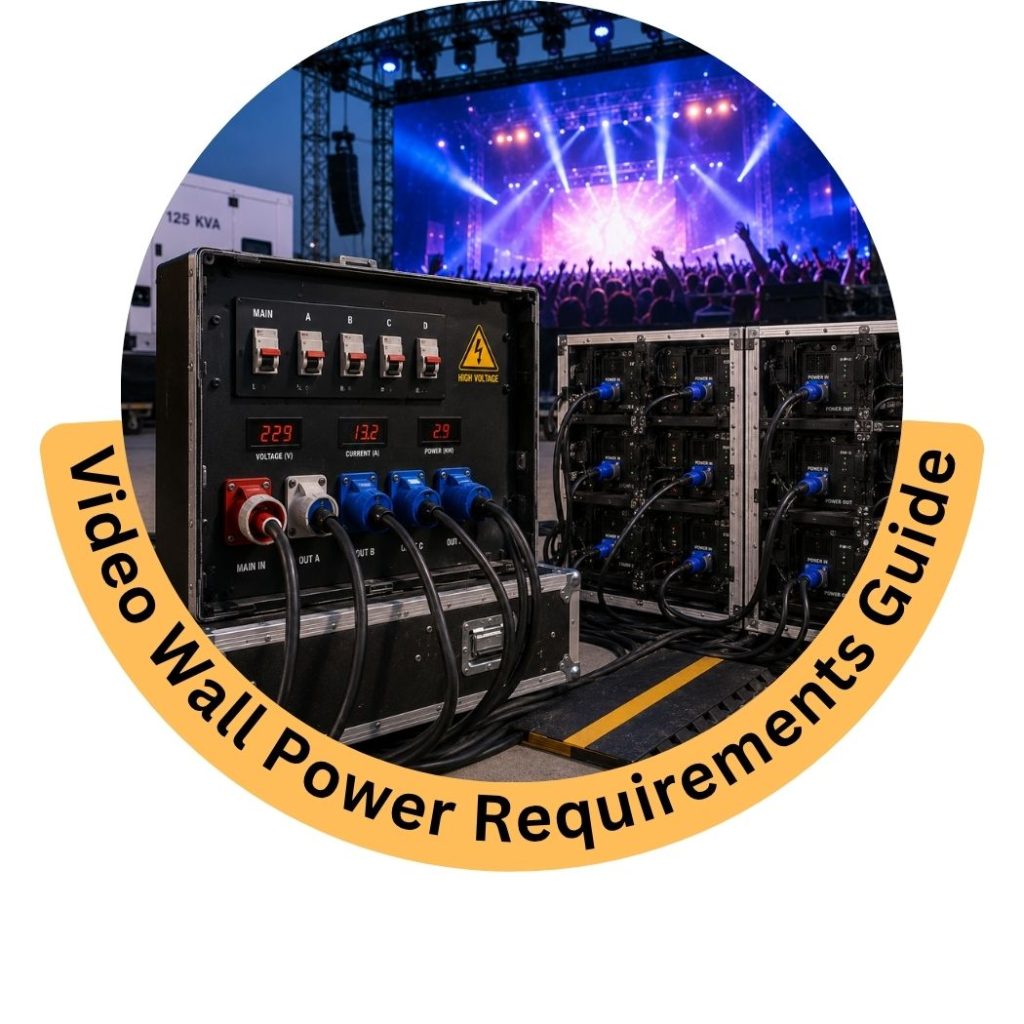
Frequently Asked Questions About Video Wall Power Requirements
How much power does a video wall need?
The amount of power required depends on the actual LED system.
The main factors include:
-
Screen dimensions
-
LED cabinet model
-
Pixel pitch
-
Brightness
-
Maximum power consumption
-
Average operating power
-
Voltage
-
Number of cabinets
-
Video processors
-
Computers
-
Switchers
-
Cameras
-
Supporting AV equipment
The electrical load should be calculated from the specifications of the equipment selected for the event.
Do all video walls use the same amount of power?
No.
Two video walls with the same physical dimensions can have different electrical requirements because they may use different:
-
LED products
-
Pixel pitches
-
Cabinet designs
-
Brightness levels
-
Power supplies
-
Efficiency ratings
Power planning should always be based on the specific LED model.
Does a larger LED wall use more power?
Generally, yes.
A larger video wall uses more LED cabinets, which increases the total potential electrical load.
The increase is not always perfectly proportional because different products have different power characteristics.
Does pixel pitch affect power consumption?
Not in a simple predictable way.
Fine-pitch LED contains more pixels in the same physical area, but actual power consumption depends on the design and efficiency of the specific product.
Manufacturer specifications should be used instead of estimating power from pixel pitch alone.
Does brightness affect LED wall power consumption?
Yes.
Higher brightness can increase power consumption.
An outdoor screen operating at high daytime brightness may draw more power than the same or similar system operating at lower brightness in a darker environment.
Does content affect power consumption?
Yes.
LED displays can use different amounts of power depending on the content being shown.
Bright full-screen content generally requires more power than darker content on many LED systems.
Does a white screen use more power than a black screen?
On many LED displays, yes.
A full white image activates red, green, and blue LED elements at high output, while a dark screen requires less output.
Electrical planning should still be based on appropriate maximum or design loads rather than relying on dark content.
Should power be calculated from average or maximum consumption?
For safe production planning, the electrical system should not be sized only around typical average consumption.
Maximum rated consumption and appropriate electrical headroom should be considered according to the equipment and electrical design.
What is the difference between average and maximum LED power consumption?
Average power consumption estimates typical operating demand under normal content.
Maximum power consumption represents a higher potential load under demanding conditions.
Both values can be useful, but electrical infrastructure must be designed so the system remains within safe operating limits.
How is video wall power calculated?
The general process involves:
-
Identifying the LED cabinet model.
-
Confirming its rated power consumption.
-
Counting the number of cabinets.
-
Calculating the total potential load.
-
Accounting for voltage.
-
Dividing the load across suitable circuits or distribution.
-
Adding supporting production equipment.
-
Maintaining appropriate electrical headroom.
A qualified technician or electrician should confirm the final design where required.
Can I calculate LED wall power from watts?
Yes.
If each cabinet has a known wattage, the approximate total wattage can be calculated by multiplying the cabinet load by the number of cabinets.
However, circuit design must also consider voltage, current, distribution, connector ratings, and applicable electrical requirements.
How do watts, volts, and amps relate?
A simplified electrical relationship is:
Watts = Volts × Amps
This can help estimate current draw when voltage and wattage are known.
Real-world system design may also need to consider additional electrical factors.
How do I calculate amps from watts?
A simplified calculation is:
Amps = Watts ÷ Volts
For example, a 2,400-watt load on a nominal 120-volt supply is approximately 20 amps before considering how the equipment should actually be distributed and operated.
Circuit loading should follow applicable electrical requirements and equipment specifications.
Can I plug a video wall into a normal wall outlet?
Small systems may operate from standard circuits in some situations.
Large professional LED walls usually require multiple circuits or dedicated temporary power distribution.
Never assume a standard outlet is sufficient without calculating the actual load.
How much power is available from a standard 120V circuit?
The nominal circuit rating may be 15 or 20 amps depending on the installation.
The usable continuous load may be lower than the full circuit rating depending on applicable electrical requirements and the type of load.
The venue or electrician should confirm usable capacity.
Can a 20-amp circuit power an LED wall?
It can power part of a system, but many professional LED walls require multiple circuits.
The number of cabinets that can safely operate on one circuit depends on:
-
Cabinet power consumption
-
Voltage
-
Power-through limits
-
Connector ratings
-
Distribution design
-
Circuit capacity
Can one circuit power an entire video wall?
Only for relatively small systems where the calculated load remains within the approved circuit capacity.
Larger displays should be divided across multiple circuits or professional distribution.
How many circuits does a video wall need?
There is no fixed number.
Circuit quantity depends on:
-
Screen dimensions
-
LED product
-
Voltage
-
Cabinet count
-
Rated power consumption
-
Distribution configuration
A small wall may require only a few circuits, while a large event wall may require substantially more power infrastructure.
What voltage do LED video walls use?
Many event systems can operate from common commercial electrical supplies, but exact voltage compatibility depends on the LED product and power system.
Professional productions may use:
-
120V distribution
-
208V service
-
240V service
-
Other supported configurations
The actual equipment specifications must be checked.
Can LED video walls run on 120 volts?
Yes, many LED systems can operate from 120V power.
However, larger screens may require many circuits if powered entirely from 120V.
Can LED video walls use 208V power?
Potentially.
Professional temporary power systems may use higher-voltage feeds and then distribute appropriate power to equipment.
The electrical system must be configured by qualified personnel.
Is 208V more efficient for large LED walls?
Higher-voltage distribution can reduce current for a given power level, which can be useful for larger systems.
However, the exact system design depends on the LED equipment, distribution hardware, venue supply, and electrical requirements.
Can a video wall use three-phase power?
Potentially.
Large event productions may use three-phase electrical service for temporary distribution.
Loads can then be balanced appropriately across phases.
What is three-phase power?
Three-phase power is a common commercial electrical system that can provide efficient distribution for larger loads.
It is frequently used for event production systems requiring substantial power.
Do I need three-phase power for my LED wall?
Not necessarily.
Smaller systems may operate entirely from standard circuits.
Larger productions may benefit from or require larger temporary electrical services depending on the total load.
What is temporary power distribution?
Temporary power distribution is a system used to safely distribute electrical service from a main source to event equipment.
It may include:
-
Distribution boxes
-
Breakers
-
Feeder cables
-
Branch circuits
-
Connectors
-
Disconnects
-
Grounding systems
What is a distro in event production?
A distro, short for power distribution unit, takes a larger electrical feed and divides it into multiple protected outputs for production equipment.
Does a video wall need a dedicated power distro?
Large systems often do.
A dedicated distribution system provides organized circuit management for the LED wall and supporting equipment.
Can the video wall share power with audio equipment?
Potentially, but the total electrical design should be coordinated.
Large audio amplifiers and LED walls can both create substantial loads.
Separating systems across properly planned circuits can simplify load management.
Can the video wall share power with lighting?
Potentially.
Lighting can require significant power, so video, lighting, and audio loads should be reviewed together before determining the final distribution system.
Should LED walls have dedicated circuits?
Often, yes.
Dedicated circuits can reduce the risk of other equipment unexpectedly increasing the load on the same branch circuit.
Can coffee makers or catering equipment share LED circuits?
They should not be assumed to.
High-draw appliances can create unexpected loads and potentially trip circuits.
Production circuits should be coordinated and clearly identified.
Can venue housekeeping outlets be used for LED walls?
Only if their capacity, circuit identification, and permitted use are confirmed.
An outlet appearing available does not mean it has sufficient or dedicated power.
How do I know whether an outlet is on its own circuit?
Venue electrical staff or a qualified electrician should confirm the circuit.
Do not assume two physically separate outlets are on different circuits.
Can multiple outlets be on the same breaker?
Yes.
This is common.
Plugging equipment into different receptacles does not necessarily provide additional electrical capacity if those receptacles share one circuit.
Why is circuit identification important?
Without proper circuit identification, multiple production loads can accidentally be connected to the same breaker.
This can lead to:
-
Tripped breakers
-
Equipment shutdown
-
Interruptions
-
Unsafe loading
What happens if an LED wall circuit is overloaded?
The circuit protection may trip, causing part or all of the LED wall to lose power.
This can interrupt the event and potentially affect other production equipment on the same circuit.
Can an overloaded circuit damage the LED wall?
Proper electrical protection is designed to interrupt unsafe loads.
However, poor power conditions, improper distribution, or repeated electrical faults can create equipment and operational risks.
What causes breakers to trip during an LED event?
Possible causes include:
-
Excessive circuit load
-
Additional equipment connected unexpectedly
-
Faulty equipment
-
Electrical faults
-
Poor distribution planning
-
Damaged cabling
-
Ground-fault conditions
Can full-white content trip breakers?
Potentially, if the electrical design was improperly sized around unrealistically low average consumption.
Power should be planned with appropriate capacity for the expected system load.
Should the LED wall be tested with bright content before the event?
Yes.
Testing with representative bright content can help confirm that the power system performs as expected.
What is electrical headroom?
Electrical headroom means leaving capacity rather than operating the power system at its absolute limit.
This helps accommodate normal variations and supports reliable system operation.
Should every circuit be loaded to 100%?
No.
Circuit loading must remain within applicable requirements and equipment ratings.
The electrical plan should include suitable headroom.
What is a continuous electrical load?
A continuous load is a load expected to operate for an extended duration as defined by applicable electrical rules.
This can affect how much of a circuit’s nominal capacity should be used.
Is an LED wall considered a continuous load?
That depends on the installation, operating duration, jurisdiction, and applicable electrical requirements.
A qualified electrician should determine the appropriate design criteria.
Do video walls need surge protection?
Professional power distribution and equipment should be configured to provide appropriate electrical protection.
The specific protection required depends on the system and environment.
Do LED walls need voltage regulation?
Not always.
However, unstable or unsuitable power can affect electronic equipment.
For sensitive productions, power quality should be reviewed.
What is dirty power?
“Dirty power” is an informal term used to describe electrical supply with undesirable characteristics such as voltage fluctuations, electrical noise, or other irregularities.
Can poor power quality affect an LED wall?
Yes.
Unstable voltage or electrical problems can potentially cause:
-
Flickering
-
Resets
-
Processor issues
-
Power-supply problems
-
Unexpected shutdowns
Should venue power be tested before installation?
For larger or critical productions, power availability and circuit capacity should be confirmed before show operation.
Who should confirm venue electrical service?
Depending on the venue and event, this may involve:
-
Venue engineering
-
House electricians
-
Event electricians
-
Production electricians
-
Technical directors
Does Video Walls DC check power requirements before installation?
The video system should be planned around the electrical requirements of the selected LED equipment and the power available at the venue.
Any venue-provided electrical service should be confirmed as part of production coordination.
Can a venue tell me how much power is available?
Yes.
Venue technical or engineering staff can often provide information about:
-
Circuit locations
-
Voltage
-
Amperage
-
Three-phase service
-
Disconnects
-
Temporary power options
Should power requirements be sent to the venue in advance?
Yes.
This gives the venue time to confirm whether suitable service is available and whether additional electrical arrangements are required.
Can a hotel ballroom power a large LED wall?
Potentially.
Many hotel ballrooms have substantial event electrical infrastructure, but available service varies by property and room.
Never assume capacity without confirmation.
Can convention centers provide LED wall power?
Usually, but available power and ordering procedures vary by venue.
Convention centers may require electrical services to be ordered through their approved provider.
Do convention centers charge separately for power?
Often.
Electrical service may be billed separately from the LED rental depending on the venue.
Can hotel power fees increase the total video wall cost?
Yes.
Venue electrical charges can affect the total event budget.
Can union electricians be required?
Potentially.
Some venues require house or union electrical labor for specific power connections or distribution work.
Can I bring my own power distribution into a venue?
Potentially, depending on venue rules and applicable electrical requirements.
Some venues allow production-owned distribution while others require approved house equipment or labor.
Do outdoor video walls need different power planning?
Yes.
Outdoor power planning must also consider:
-
Weather
-
Ground conditions
-
Cable protection
-
Moisture
-
Generator use
-
Long cable runs
-
Temporary electrical distribution
Can outdoor LED walls use venue power?
Yes, where suitable outdoor-rated electrical service and sufficient capacity are available.
Do outdoor LED walls usually need generators?
Not always.
Generators are common when:
-
The event is in a park
-
The screen is far from permanent power
-
Available service is insufficient
-
Temporary distribution is more practical
How big a generator does an LED wall need?
Generator size depends on the total electrical load of:
-
LED wall
-
Video processing
-
Cameras
-
Audio
-
Lighting
-
Computers
-
Supporting systems
The generator should be sized around the complete production rather than the LED wall alone.
Should generator size be based on maximum LED load?
The generator plan should account for realistic maximum system demand and appropriate headroom.
A qualified production electrician or generator provider should confirm the final size.
Can a generator be too small?
Yes.
An undersized generator can cause:
-
Voltage instability
-
Breaker trips
-
Equipment shutdown
-
Poor performance
Can a generator be too large?
A larger generator is not automatically problematic, but unnecessarily oversized equipment can increase cost, fuel use, footprint, and logistics.
Generator sizing should be appropriate to the load.
Can one generator power the LED wall, audio, and lighting?
Potentially.
The total load, phase balancing, distribution, grounding, and operational requirements must be reviewed.
Is it better to use separate generators for video and audio?
Sometimes.
Separate systems can provide isolation or redundancy, but the best configuration depends on the event.
Does a generator need grounding?
Temporary generator grounding and bonding requirements depend on the generator configuration and applicable electrical codes.
A qualified electrician should determine the correct setup.
Can generators cause noise problems?
Yes.
Generator placement should consider:
-
Stage microphones
-
Audience areas
-
Neighboring properties
-
Camera positions
-
Production control
-
Ventilation
Can a generator be placed close to the LED screen?
Potentially, but placement must consider:
-
Exhaust
-
Heat
-
Noise
-
Fuel
-
Safety clearances
-
Cable routing
-
Audience access
Can generators be placed inside a building?
Only equipment specifically approved and installed for that environment should be used.
Portable combustion generators should not be assumed safe for indoor operation due to exhaust and carbon monoxide hazards.
Can an outdoor event use battery power instead of a generator?
Potentially for certain smaller systems or specialized battery-storage installations.
Large LED walls can require substantial energy, so battery capacity, runtime, output, and recharge logistics must be carefully calculated.
Can solar power run a video wall?
Potentially as part of a properly engineered energy system, but event LED walls often require power levels that make direct solar-only operation impractical without significant battery storage and electrical infrastructure.
Can a mobile LED trailer have its own generator?
Yes.
Some mobile LED trailer systems include integrated or paired power solutions.
Exact capabilities depend on the specific trailer.
Does a mobile LED trailer use less power than a modular wall?
Not necessarily.
Power depends primarily on the display technology, screen area, brightness, and supporting systems.
Do outdoor displays use more power because they are brighter?
Often, yes.
Outdoor systems commonly operate at higher brightness than indoor displays, which can increase electrical demand.
Does nighttime outdoor operation use less power?
It may.
Brightness is often reduced after dark, which can lower actual power consumption.
The electrical system should still be sized appropriately for the equipment.
Does dimming the LED wall reduce power consumption?
Generally, yes.
Lower brightness can reduce actual power usage on many LED systems.
Can brightness automatically change during an event?
Potentially.
Brightness may be adjusted manually or through supported control systems as daylight changes.
Should power be planned for daytime brightness even if the event continues at night?
Yes.
If the display will operate during daylight, the system should be capable of supporting its required daytime operating conditions.
Do LED processors use much power?
Processors usually use far less power than the LED wall itself, but they still need reliable power.
Do presentation computers need separate power?
Yes.
Show computers should have dedicated reliable power as part of the production system.
Should video processors and computers share the same circuit as the LED wall?
They can in some designs, but critical control equipment may benefit from carefully planned circuits or protected power.
Should critical video equipment use UPS backup?
Potentially.
Uninterruptible power supplies can provide short-term backup or conditioning for:
-
Processors
-
Switchers
-
Computers
-
Network equipment
-
Control systems
They are generally not intended to power a large LED wall for extended periods.
Can a UPS run an entire LED wall?
Usually not for meaningful runtime unless the UPS system is specifically engineered for a very large load.
Standard event UPS systems are more commonly used for control electronics.
Why use UPS power for processors?
A UPS can help keep control equipment running through brief power interruptions and may reduce restart time if a branch circuit experiences a momentary issue.
Can an LED wall stay on if the processor loses power?
The panels may remain powered, but the displayed image can be lost or disrupted if processing equipment shuts down.
Should LED processors have backup power?
For critical events, backup planning can be useful.
The appropriate redundancy depends on the production.
Can redundant power supplies be used in LED cabinets?
Some LED products offer redundant power or signal options.
Capabilities depend on the specific equipment.
Does redundant power mean the LED wall cannot fail?
No.
Redundancy reduces some single points of failure but does not guarantee uninterrupted operation under every condition.
Can two separate electrical sources improve redundancy?
Potentially, but redundancy must be carefully engineered.
Improperly combining separate power sources can create serious electrical hazards.
Should redundant feeds come from different circuits?
Potentially.
A production electrician should design any redundant electrical architecture.
Can I switch an LED wall from venue power to generator power during an event?
Potentially, but transfer between power sources must be properly designed.
Do not attempt ad hoc source switching on a live production system.
What is an automatic transfer switch?
An automatic transfer switch moves a load between approved electrical sources according to its designed operation.
It is used in some backup-power systems.
Do event LED walls normally use automatic transfer switches?
Not necessarily.
The need depends on the scale and redundancy requirements of the event.
What power connectors do LED video walls use?
Professional LED equipment may use various locking or ruggedized connectors depending on the manufacturer and system.
Connector type should match the LED product and approved distribution equipment.
Can regular household extension cords power an LED wall?
They should not automatically be used for professional high-load systems.
Cable gauge, connector rating, cable length, environmental rating, and circuit load all matter.
Why does cable gauge matter?
Long or undersized cables can create excessive voltage drop and heat.
Power cables should be appropriately rated for the load and distance.
What is voltage drop?
Voltage drop is the reduction in voltage that occurs as current travels through electrical conductors.
It becomes more significant with:
-
Longer cable runs
-
Higher current
-
Smaller conductors
Can voltage drop affect an LED wall?
Yes.
Excessive voltage drop can contribute to unreliable operation or power-supply problems.
Are longer power cables a problem?
They can be if cable gauge and distribution are not designed for the distance.
Long-distance power runs should be planned appropriately.
Is it better to place distribution closer to the LED wall?
Often.
Positioning branch distribution appropriately can reduce unnecessarily long high-current cable runs.
Can power and video cables run together?
They can sometimes share routes, but cable planning should consider signal integrity, electrical safety, venue requirements, and cable management.
Should power and signal cables be separated?
Depending on the signal type and installation, separation can help reduce interference and simplify cable management.
Can cables be run under carpet?
Only using appropriate methods and products allowed by the venue and applicable safety requirements.
Can power cables run across doorways?
Cable paths should avoid creating trip hazards or blocking required exits.
Where crossings are unavoidable, suitable protection and venue-approved routing should be used.
Can power cables run through audience areas?
Potentially, but cable routing should minimize audience exposure and use appropriate cable protection.
Do power cables need cable ramps outdoors?
Often, where cables cross pedestrian or vehicle areas.
The exact protection depends on traffic type and site requirements.
Do outdoor power connections need weather protection?
Yes.
Electrical connectors and distribution equipment must be suitable for the environment and installed appropriately.
Can power connectors sit in puddles?
No.
Outdoor electrical systems should be positioned and protected to avoid water accumulation and unsafe conditions.
What happens if it rains on outdoor power distribution?
Outdoor power equipment should be selected and protected according to its environmental rating and the event’s electrical and weather plan.
Are ground-fault protection devices required outdoors?
Ground-fault protection requirements depend on applicable electrical codes, jurisdiction, equipment, and temporary-power configuration.
A qualified electrician should determine the required protection.
What is GFCI protection?
A Ground-Fault Circuit Interrupter is designed to quickly interrupt power when certain leakage-to-ground conditions are detected.
Can GFCIs cause nuisance trips with LED equipment?
Electronic equipment can sometimes interact with protective devices in complex ways, but required safety protection should never be bypassed.
The electrical system should be designed correctly for the equipment.
Should electrical safety devices ever be defeated to keep the LED wall running?
No.
Protective devices should not be bypassed or defeated to prevent nuisance shutdowns.
The underlying electrical issue should be identified and corrected.
Can daisy-chaining power strips cause problems?
Yes.
Consumer power strips and uncontrolled daisy-chaining should not be used as a substitute for properly designed event power distribution.
Can LED cabinets be daisy-chained for power?
Many professional LED systems support approved power-through connections between cabinets.
The maximum number of cabinets per chain must follow the equipment specifications.
How many LED cabinets can be connected on one power chain?
That depends on:
-
Cabinet wattage
-
Voltage
-
Connector rating
-
Cable rating
-
Manufacturer limits
-
Circuit capacity
There is no universal number.
What happens if too many cabinets are connected together?
The circuit, cable, connector, or upstream protection may be overloaded.
Always follow the equipment’s approved power-through limits.
Can separate rows of LED panels use separate circuits?
Yes.
Professional walls are often divided into logical power zones.
Should the LED wall be split into multiple power zones?
Larger screens usually are.
Power zoning can simplify distribution and limit the amount of screen affected by a single circuit issue.
If one circuit trips, will the entire wall go black?
Not necessarily.
If the wall is divided into multiple power zones, only the cabinets on the affected circuit may lose power.
Can power zoning improve reliability?
Yes.
Properly distributed loads can reduce the impact of a single branch-circuit issue.
Can the left and right sides of the screen use different circuits?
Yes.
The exact zoning depends on cabinet layout and system design.
Should power phases be balanced?
For multi-phase systems, yes.
Electrical loads should be appropriately balanced according to the distribution design.
What does phase balancing mean?
Phase balancing means distributing electrical loads across available phases so one phase is not disproportionately loaded.
Who balances the electrical phases?
A qualified electrician or experienced production power technician should manage the distribution.
Does the video wall need its own electrician?
Not every event requires a dedicated production electrician.
However, larger temporary electrical systems, three-phase feeds, generators, or venue tie-ins may require qualified electrical personnel.
Can LED technicians make electrical tie-ins?
Only if they are appropriately qualified and permitted to perform that work.
Electrical connections must follow venue rules and applicable law.
What is a venue electrical tie-in?
A tie-in involves connecting temporary event distribution to a building’s electrical service or disconnect.
This is specialized work that should be performed only by qualified and authorized personnel.
Can I connect directly to a building electrical panel?
Not without proper authorization and qualified electrical personnel.
Does a large LED wall require an electrical permit?
Potentially.
Requirements vary by jurisdiction, venue, temporary-power system, generator, and installation.
Who is responsible for electrical permits?
Responsibility should be established between the organizer, venue, production provider, electrician, and other relevant parties.
Do outdoor generators require permits?
Potentially.
Local regulations may apply to temporary generators, fuel, noise, emissions, placement, and electrical distribution.
Do power requirements affect where the video wall can be installed?
Yes.
A screen location may be limited by:
-
Available electrical service
-
Cable distance
-
Generator access
-
Distribution footprint
-
Safety requirements
Can the LED wall be far from the electrical source?
Yes, with appropriately designed power distribution.
Long distances may require larger conductors or relocation of distribution equipment.
Does distance from power increase rental cost?
Potentially.
Long cable runs, larger feeder cables, additional distribution, or generator requirements can increase production scope.
Does venue power availability affect video wall rental cost?
Yes.
If suitable power is already available near the screen location, less temporary electrical infrastructure may be required.
Can generator rental increase video wall cost?
Yes.
Generator-related costs may include:
-
Generator
-
Fuel
-
Delivery
-
Electrical distro
-
Feeder cable
-
Labor
-
Monitoring
Does a larger LED wall require more electrical labor?
Potentially.
More circuits, feeders, distribution equipment, and cable runs can increase setup complexity.
Is electrical power included in a video wall rental quote?
That depends on the scope.
The LED rental quote may include equipment power distribution while venue electrical service, house electricians, generator rentals, or utility charges may be separate.
Should I ask whether power is included before comparing video wall quotes?
Yes.
Two quotes can differ significantly if one includes temporary electrical distribution or venue-related power costs and the other does not.
What electrical items should I compare between quotes?
Check whether the quote includes:
-
Power distribution
-
Feeder cable
-
Branch circuits
-
Generator
-
Generator fuel
-
Electrical labor
-
Venue power
-
Overnight power
-
Backup power
-
UPS for control equipment
Does screen brightness affect generator size?
Potentially.
Higher brightness can increase LED load, especially for large outdoor displays.
Does running video instead of PowerPoint change power requirements?
Actual consumption can vary with content, but the electrical system should not be sized around one specific presentation type unless supported by an engineered load-management plan.
Do animated graphics use more power than static slides?
Not necessarily.
Overall image brightness is usually more relevant than whether the content moves.
Do dark event graphics save power?
They can reduce actual consumption on many LED systems, but production power should still have adequate capacity for brighter content.
Does LED wall standby mode use power?
Yes, although substantially less than full operation depending on the equipment.
Should an LED wall be turned off between sessions to save power?
It can be, but operational decisions should consider boot-up time, testing, event schedules, and technical requirements.
Can frequent power cycling damage an LED wall?
LED systems are designed for normal power cycles, but unnecessary repeated cycling is generally avoided during live production.
How long does an LED wall take to power up?
Typically only a short period, but complete system startup also includes processors, computers, signal checks, mapping, and content verification.
Should the LED wall be powered before rehearsal?
Yes.
The system should be fully powered, configured, and tested before rehearsal begins.
Should power stay on during lunch breaks?
Often, yes, particularly for multi-session conferences.
This reduces the need to restart and retest the system.
Can the screen remain powered overnight?
Potentially.
This depends on venue rules, production requirements, overnight staffing, electrical policies, and equipment needs.
Is overnight power charged separately by venues?
It can be.
Convention centers and hotels may charge for continuous or overnight electrical service.
Does a multi-day event require different power planning?
The basic load may remain the same, but multi-day productions may also require:
-
Overnight power
-
Security
-
Daily testing
-
Generator fuel planning
-
Extended electrical service
Can generators run continuously for multi-day events?
Yes, if the generator system, fueling plan, maintenance schedule, noise requirements, and operating procedures are appropriate.
Do generators need refueling during an event?
Potentially.
Fuel consumption depends on generator size, load, runtime, and fuel capacity.
Should generators be refueled while running?
Fueling procedures must follow the generator provider’s safety requirements and applicable regulations.
Can generator fuel run out during an event?
Yes, without proper planning and monitoring.
Fuel capacity and runtime should be calculated before the event.
Should a technician monitor generator load?
For larger productions, monitoring power and generator performance can be valuable.
Can load meters be used on video wall power systems?
Yes.
Professional distribution equipment may provide current or load monitoring.
Why monitor electrical load during setup?
Load monitoring can help confirm that circuits and phases are operating within the planned range.
Should the video wall be tested at full brightness?
For outdoor systems or other high-brightness applications, testing representative high-load conditions can help verify the power design.
Can LED power consumption suddenly increase during the show?
Yes.
A transition from dark content to a bright full-screen image can increase actual demand.
Should power design account for worst-case content?
The electrical design should provide appropriate capacity for the equipment and expected operating conditions rather than relying solely on low average consumption.
Does power affect LED wall image quality?
Indirectly.
Insufficient or unstable electrical supply can contribute to resets, outages, or equipment problems.
Can low voltage cause LED panels to flicker?
Potentially.
Electrical problems can affect LED power supplies and other electronics.
Can voltage fluctuations cause processors to restart?
Potentially.
Sensitive electronics require appropriate power quality.
Can a UPS prevent processor restarts?
It can help during certain short-duration interruptions or voltage events, depending on the UPS design.
Should media servers use UPS power?
For critical events, it can be useful.
Should presentation laptops use UPS power?
Potentially, although laptops have internal batteries that already provide some short-term protection.
Supporting adapters and external devices should also be considered.
Do cameras require separate electrical power?
Yes, unless powered through batteries or supported camera infrastructure.
Camera, intercom, monitoring, and video systems should be included in the overall production power plan.
Do confidence monitors add much electrical load?
Individual monitors typically add relatively modest loads compared with a large LED wall, but they should still be accounted for.
Do LED posters require separate power?
Yes.
Each display requires suitable electrical service.
Do KIOSKs require power?
Yes.
Interactive KIOSKs typically require electrical power and may also require network connectivity depending on their application.
Do TV monitors require separate circuits?
Often they can share appropriately calculated circuits, depending on quantity and load.
Does audio power need to be included in the same event load calculation?
Yes, when planning the complete production electrical demand.
Does lighting power need to be included?
Yes.
Event lighting can be a significant part of the total electrical load.
Can venue HVAC or catering affect available event power?
Potentially, depending on building infrastructure.
Production power should be coordinated with the venue rather than assuming all electrical capacity is available to the event.
Can temporary air conditioning affect generator sizing?
Yes.
If cooling equipment is being powered from the same temporary electrical system, it must be included in the total load.
Does an outdoor control tent need electrical power?
Yes.
The control area may require power for:
-
Processors
-
Computers
-
Switchers
-
Monitors
-
Networking
-
Communications
-
Cooling
Can processors overheat if the control area is too hot?
Yes.
Electronic equipment should be operated within suitable temperature ranges and ventilation conditions.
Does cooling equipment increase the power requirement?
Yes.
Air conditioning or ventilation systems should be included in the overall load if powered from the event system.
Should electrical load be included in site planning?
Yes.
Electrical planning should be coordinated with:
-
Screen position
-
Stage
-
Front of house
-
Generator placement
-
Cable routes
-
Audience circulation
-
Venue access
How early should video wall power requirements be confirmed?
As early as practical, especially for:
-
Large LED walls
-
Outdoor events
-
Convention centers
-
Rigged systems
-
Generator-powered events
-
Multi-screen productions
What happens if adequate power is discovered to be unavailable during load-in?
The production may require:
-
Additional circuits
-
Temporary distribution
-
Generator power
-
Reduced system scope
-
A revised screen location
This is why electrical planning should occur before installation.
Can the screen size be reduced if power is limited?
Potentially.
Reducing screen area can reduce the number of LED cabinets and therefore total electrical demand.
Can brightness be reduced instead of reducing screen size?
Potentially, but brightness should not be used as the only solution if the electrical infrastructure is fundamentally undersized.
Can a lower-power LED product be selected?
Potentially.
Different LED systems have different electrical characteristics.
Equipment selection can be reviewed as part of the design process.
Can power limitations affect pixel pitch selection?
Indirectly.
Different products may have different electrical requirements, so equipment selection can influence the final load.
Can power limitations affect outdoor screen size?
Yes.
If the site has limited electrical capacity and generator use is restricted, screen size may need to be reconsidered.
Can multiple LED walls share one power distro?
Yes, if the distribution system is correctly sized and the loads are properly managed.
Can different rooms share one electrical source?
Potentially.
This depends on building infrastructure, distribution distance, load, and event layout.
Do multi-room conferences require more power planning?
Yes.
Multiple rooms can involve:
-
Several LED walls
-
Projection
-
TV monitors
-
Audio
-
Lighting
-
Cameras
-
Presentation systems
A room-by-room electrical plan may be needed.
Can one room trip power in another room?
Potentially, if both rooms share upstream electrical infrastructure.
Venue engineering should confirm how circuits and distribution are arranged.
Do LED walls need emergency power?
Not normally unless the event has specific operational requirements.
An LED wall should not be assumed to be part of a venue’s required life-safety or emergency system.
Can the LED wall display emergency messages if normal power fails?
Only if the video system remains powered through an appropriately designed backup system.
It should not replace required emergency communication systems.
Should emergency exits have separate power from event equipment?
Life-safety systems are governed separately and should not depend on temporary event-production power.
Can a video wall interfere with venue emergency power?
Temporary production electrical systems should be coordinated with the venue so they do not compromise building systems.
Is electrical planning a safety issue or just a technical issue?
Both.
Improper temporary power can create risks involving:
-
Electrical shock
-
Fire
-
Equipment failure
-
Cable hazards
-
Event interruption
Who should install event power distribution?
Appropriately qualified technicians or electricians should install and manage electrical systems according to the scale of the production, venue rules, and applicable requirements.
Can clients provide their own extension cords?
Only if the equipment is appropriate, rated, approved, and incorporated into the production plan.
Professional events should not rely on unknown consumer cabling.
Can damaged cables be used temporarily?
No.
Damaged electrical cables or connectors should be removed from service.
Should connectors be inspected during setup?
Yes.
Power cables, connectors, distribution equipment, and LED cabinets should be visually inspected as part of system setup.
Can hot connectors indicate a problem?
Yes.
Unusual heat can indicate excessive load, poor connection, damage, or another electrical problem and should be investigated.
What should happen if a cable smells hot or looks damaged?
Power should be managed safely and the equipment should be inspected by qualified personnel.
Do not continue using visibly damaged electrical equipment.
Can LED walls create electrical hazards for attendees?
A professionally installed system should keep electrical infrastructure controlled and protected.
Audience areas should be separated from:
-
Distribution equipment
-
Exposed connectors
-
Generators
-
Unprotected cable runs
Should LED wall power equipment be barricaded?
Potentially.
Distribution panels, generators, and other technical equipment may require controlled access depending on the event.
Does rain increase electrical risk outdoors?
Yes.
Outdoor electrical systems require appropriate equipment, protection, cable management, and operating procedures.
Should outdoor power be shut down during severe weather?
Potentially.
The event weather and electrical safety plan should define when systems must be shut down.
Who decides whether outdoor power should be shut down?
This should be handled according to the event’s established safety procedures involving relevant production, venue, electrical, and organizer personnel.
Can lightning affect temporary event power?
Yes.
Lightning is a serious outdoor-event hazard and should be addressed through the event’s weather and safety plan.
Does an LED wall need power during installation?
Yes, but power should be applied according to the installation and testing process.
Cabinets are generally assembled and then powered for configuration and testing.
Should LED cabinets be powered while being connected?
Technicians should follow the manufacturer’s approved installation procedures and electrical safety practices.
Does the LED wall need to be powered before content is connected?
The exact sequence depends on the equipment and workflow.
Professional technicians manage startup according to the system design.
Can sudden power loss corrupt LED settings?
Potentially, depending on the equipment and control system.
Professional systems should have configuration files and backup procedures where appropriate.
Should LED configuration files be backed up?
Yes.
Maintaining processor and screen-mapping files can speed recovery if equipment needs to be replaced or reconfigured.
Can power loss affect PowerPoint presentations?
It can affect external display output and supporting production systems.
Presentation laptops with batteries may remain powered, but switchers, processors, and displays may not.
Can power loss affect cameras?
Yes.
Cameras, converters, monitors, and switching systems may lose power unless backup systems are available.
Can an entire event production run from one generator?
Potentially.
The generator and distribution must be properly sized for the complete load.
Is it better to calculate power room by room?
For multi-room events, yes.
A room-by-room load schedule helps identify circuit and distribution requirements.
Should every piece of AV equipment be included in the power calculation?
Ideally, yes.
Even smaller loads add up across a large production.
Do phone chargers and laptops matter?
Individually, they are minor, but production power should remain controlled so unexpected devices do not overload dedicated circuits.
Should attendees plug into video wall circuits?
No.
Production circuits should remain reserved for the intended technical equipment.
Can exhibitors share power with a trade-show LED wall?
Only if the electrical system is designed and approved for both loads.
Does a trade-show booth LED wall require ordered electrical service?
Often.
Trade shows commonly require exhibitors to order electrical service through the venue or approved provider.
Does booth size affect power requirements?
Indirectly.
A larger booth may accommodate a larger LED wall and more equipment.
Can fine-pitch trade-show LED run from booth power?
Yes, if the ordered electrical service is sufficient for the selected system.
Should power be ordered before the trade show?
Yes.
Electrical service should be arranged based on the final equipment design and show deadlines.
Can late electrical orders cost more?
Potentially.
Many venues and trade shows have advance-order deadlines and higher onsite rates.
Does a conference LED wall require more power than projection?
Often, but not always.
Large LED walls can require more electrical power than a projector setup, while projection may involve different lighting and space requirements.
Does LED use less power than LCD video walls?
It depends on the physical display area, equipment, brightness, and technology.
Comparisons should use actual equipment specifications.
Does power consumption affect operating cost?
Potentially.
Venue electrical fees, generator fuel, temporary distribution, and electrical labor can all affect the total event cost.
Is LED power consumption important for sustainability planning?
Yes.
Equipment efficiency, screen size, brightness, operating hours, and generator use can all influence event energy consumption.
Can turning brightness down save energy?
Yes.
Reducing unnecessary brightness can lower actual consumption while also improving viewing comfort in darker environments.
Can the screen be turned off when not needed?
Yes.
If the event schedule allows, the display can be powered down during extended unused periods.
Should energy-saving decisions be planned before the event?
Yes.
Production teams can plan operating hours and brightness levels without compromising show requirements.
What information is needed to calculate video wall power requirements?
Provide:
-
Event date
-
Venue
-
Indoor or outdoor location
-
Screen dimensions
-
LED product if known
-
Pixel pitch
-
Number of LED walls
-
Operating brightness
-
Event duration
-
Daytime or nighttime use
-
Available voltage
-
Available circuits
-
Venue power information
-
Existing electrical distribution
-
Generator availability
-
Distance from power source
-
Cameras
-
Video processors
-
Presentation systems
-
Audio requirements
-
Lighting requirements
-
Additional displays
-
Multi-room requirements
-
Load-in schedule
-
Rehearsal schedule
-
Overnight operation
These details allow the electrical system to be planned around the actual LED load, circuit capacity, voltage, distribution, operating conditions, and supporting production equipment.
Can Video Walls DC calculate the power requirements for my LED wall?
Yes.
Video Walls DC can determine the electrical requirements of the selected LED system and coordinate the production design around screen size, LED cabinet load, available circuits, temporary power distribution, generator requirements, video processing, supporting AV, and venue infrastructure.
Venue-provided electrical service or specialized electrical tie-ins should be confirmed with the appropriate venue or electrical provider.
How do I get a video wall quote that includes power requirements?
Send us your event date, venue, screen dimensions, indoor or outdoor requirements, audience size, production equipment, available venue power, generator requirements, and event schedule.
We can then configure the video wall and identify the electrical requirements for the planned system.