
Video Wall Pixel Pitch Guide
Pixel pitch is one of the most important specifications when selecting an LED video wall.
It directly affects pixel density, image detail, closest practical viewing distance, native resolution, content clarity, and equipment cost.
This Video Wall Pixel Pitch Guide answers the most common questions about choosing the right LED pixel pitch for conferences, corporate events, trade shows, medical events, research presentations, galas, outdoor events, concerts, graduations, fan zones, and other live productions.
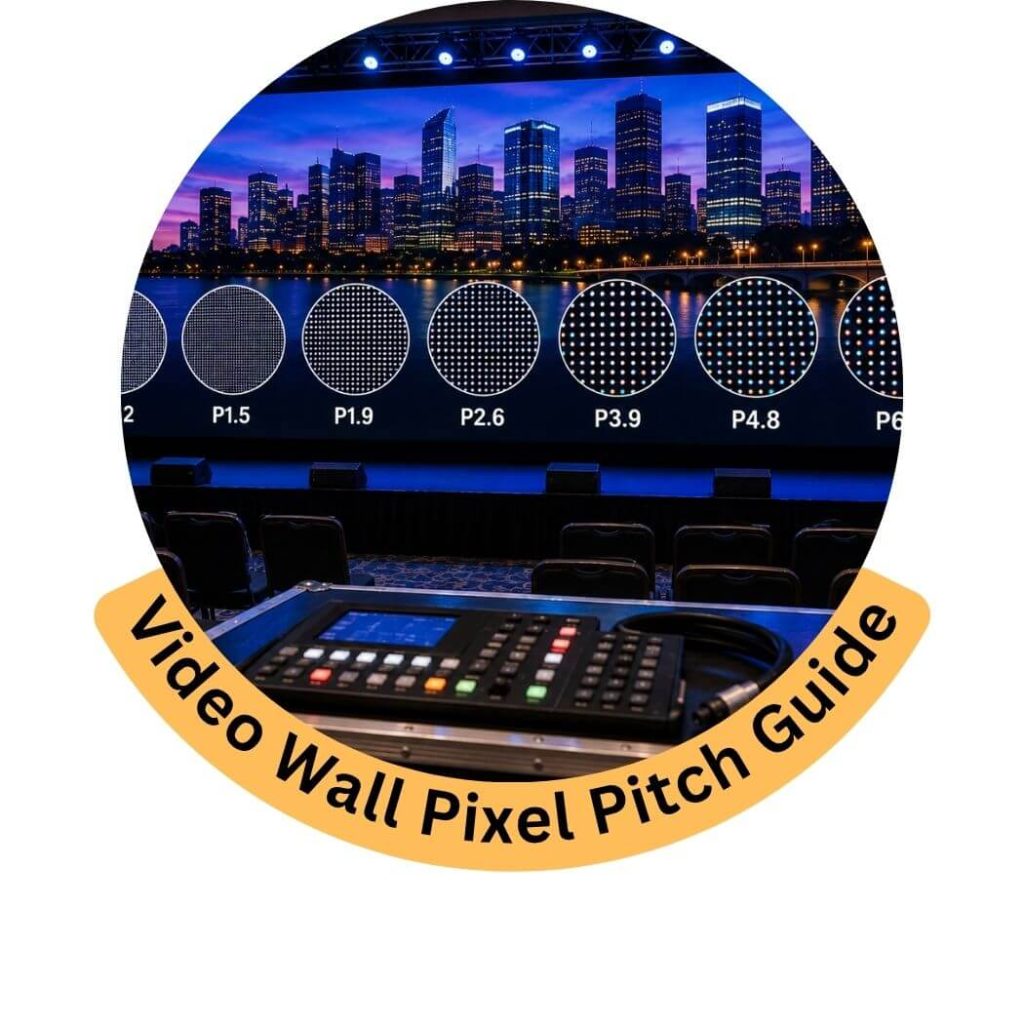
Frequently Asked Questions About Video Wall Pixel Pitch
What is video wall pixel pitch?
Pixel pitch is the distance between the centers of neighboring LED pixels on a display.
It is typically measured in millimeters.
For example, a 2.6 mm pixel pitch means neighboring pixels are approximately 2.6 millimeters apart.
Why is pixel pitch important?
Pixel pitch affects:
-
Pixel density
-
Image detail
-
Closest viewing distance
-
Native resolution
-
Text clarity
-
Camera appearance
-
Presentation quality
-
Rental cost
The correct pixel pitch should be selected around the actual audience and content requirements.
What does a smaller pixel pitch mean?
A smaller pixel pitch means the pixels are positioned closer together.
This creates greater pixel density within the same physical screen area.
Fine-pitch LED can therefore produce smoother-looking images when viewed from shorter distances.
What does a larger pixel pitch mean?
A larger pixel pitch means the pixels are spaced farther apart.
Larger-pitch LED is often practical when viewers are farther from the screen, such as at:
-
Outdoor events
-
Concerts
-
Festivals
-
Graduations
-
Fan zones
-
Sporting events
-
Large public gatherings
Is smaller pixel pitch always better?
No.
A smaller pixel pitch provides more pixels, but that does not automatically make it the best choice for every event.
If the audience is far from the screen, extremely fine-pitch LED may provide little visible benefit while increasing equipment cost.
What is fine-pitch LED?
Fine-pitch LED generally refers to LED displays with relatively small pixel spacing designed for close-viewing environments.
They are commonly used for:
-
Conferences
-
Corporate events
-
Medical presentations
-
Research programs
-
Trade shows
-
Executive meetings
-
Control-room-style presentations
-
Close audience seating
What is considered a fine pixel pitch?
There is no single universal cutoff.
In event production, the term is commonly used for relatively small-pitch LED products intended for short viewing distances and high-detail content.
The exact product should be selected based on the event rather than terminology alone.
What pixel pitch is best for indoor events?
Indoor pixel pitch depends on:
-
Closest audience distance
-
Screen size
-
Presentation detail
-
Venue dimensions
-
Budget
-
Camera requirements
Indoor conferences and corporate events commonly benefit from finer pixel pitch because attendees may sit relatively close to the screen.
What pixel pitch is best for outdoor events?
Outdoor events often allow larger pixel pitches because audiences usually view the display from farther away.
The correct choice depends on:
-
Closest viewing distance
-
Audience depth
-
Screen dimensions
-
Screen elevation
-
Content
-
Event type
Does outdoor LED always use a larger pixel pitch?
Not always.
Some outdoor applications require relatively close viewing, such as branded activations or compact audience areas.
Pixel pitch should still be selected from viewing distance rather than simply categorizing the event as indoor or outdoor.
How does pixel pitch affect viewing distance?
Pixel pitch strongly affects how close viewers can stand or sit before individual pixels become noticeable.
Smaller pitches support shorter comfortable viewing distances.
Larger pitches are generally more appropriate for longer viewing distances.
How do I choose pixel pitch from viewing distance?
Start by identifying the closest normal audience position.
Then consider:
-
Content detail
-
Screen dimensions
-
Budget
-
Audience expectations
-
Camera use
-
Whether attendees will approach the display closely
Viewing distance formulas can provide a rough reference, but final equipment selection should consider the complete event.
Is there a simple pixel-pitch viewing-distance formula?
You may see simplified rules that compare pixel pitch in millimeters with approximate viewing distance in meters.
These can be useful as a starting point but should not be treated as exact engineering rules.
Different content and viewing expectations can produce different practical results.
Can I choose pixel pitch using only a formula?
Not reliably.
A formula does not account for:
-
Small text
-
Detailed charts
-
Medical graphics
-
Software demonstrations
-
Camera framing
-
Screen dimensions
-
Audience expectations
These factors should also influence the final choice.
What happens if the pixel pitch is too large?
If viewers are too close to a larger-pitch display, they may notice:
-
Individual pixels
-
Pixel structure
-
Reduced image smoothness
-
Less comfortable text viewing
-
Less detailed graphics
What happens if the pixel pitch is finer than necessary?
The image may look excellent, but the additional pixel density may not provide a meaningful visual benefit at the actual viewing distance.
This can increase the rental cost unnecessarily.
Does finer pixel pitch increase resolution?
Yes.
For two LED walls with identical physical dimensions, the finer-pitch wall will normally contain more pixels and therefore have a higher native resolution.
Can two same-size video walls have different resolutions?
Yes.
For example, two screens may both be the same width and height but use different pixel pitches.
The finer-pitch screen will contain more pixels across and vertically.
Does pixel pitch determine physical screen size?
No.
Pixel pitch determines pixel density.
Physical screen dimensions are determined by:
-
Stage size
-
Audience depth
-
Viewing distance
-
Venue dimensions
-
Content
-
Event design
The two factors should be planned together.
Should I choose screen size first or pixel pitch first?
Usually they should be considered together.
A typical design process is:
-
Review the room or event site.
-
Determine audience sightlines.
-
Establish screen dimensions.
-
Identify closest viewing distance.
-
Select appropriate pixel pitch.
-
Calculate native resolution.
-
Confirm content workflow.
Does a larger video wall need finer pixel pitch?
Not necessarily.
A large video wall viewed from farther away may work well with a larger pixel pitch.
Fine pitch is most useful where the audience is close or the content contains significant detail.
Does a smaller video wall need finer pixel pitch?
Often, but not automatically.
Small screens are frequently used in smaller rooms where audiences sit closer, which can make finer pitch more appropriate.
The viewing distance remains the key factor.
How does pixel pitch affect PowerPoint presentations?
Finer pixel pitch can improve the appearance of:
-
Text
-
Charts
-
Lines
-
Tables
-
Icons
-
Detailed diagrams
This is particularly useful when attendees sit close to the screen.
What pixel pitch is best for PowerPoint?
The appropriate pitch depends on:
-
Closest viewing distance
-
Font size
-
Slide complexity
-
Screen dimensions
-
Audience depth
Fine-pitch LED is generally useful for detailed presentation environments.
Can large-pitch LED display PowerPoint?
Yes.
The issue is not whether it can display PowerPoint, but whether the content looks appropriate from the intended viewing distance.
Small text may appear coarse when viewed too closely.
Does PowerPoint resolution need to match pixel pitch?
No.
The presentation source can be scaled to the native LED canvas using professional video processing.
However, content designed around the final pixel dimensions can provide better control for custom canvases.
How does pixel pitch affect text readability?
Pixel pitch affects how smoothly characters and lines are rendered.
At close distances, fine-pitch LED can make smaller text appear cleaner.
At long distances, physical font size often matters more than additional pixel density.
Can fine-pitch LED make tiny text readable from the back of a room?
No.
Fine pitch improves image detail, but it does not make text physically larger.
For distant viewers, larger screen dimensions and larger text are more important.
What matters more for rear-row viewers: pixel pitch or screen size?
Usually screen size.
At long viewing distances, physical content size often becomes more important than very fine pixel density.
What matters more for front-row viewers?
Pixel pitch becomes more important because front-row attendees are close enough to notice pixel structure.
Does pixel pitch affect charts and graphs?
Yes.
Fine pitch can improve the rendering of:
-
Thin lines
-
Small labels
-
Detailed charts
-
Graph legends
-
Data points
However, charts should still be designed for the audience distance.
What pixel pitch is best for medical conferences?
Medical conferences often involve:
-
Detailed graphics
-
Scientific diagrams
-
Charts
-
Research data
-
Fine text
Fine-pitch LED is generally more appropriate where viewers are relatively close.
Any diagnostic or regulated clinical viewing requirements should be defined separately by the organizer.
What pixel pitch is best for research presentations?
Fine-pitch LED is often useful because research content may include:
-
Tables
-
Charts
-
Data visualization
-
Diagrams
-
Technical images
-
Small annotations
The correct pitch still depends on viewing distance.
What pixel pitch is best for financial conferences?
Financial presentations frequently contain tables, market data, charts, and multiple information windows.
Fine-pitch LED can improve clarity for audiences viewing this detailed content at close or moderate distances.
What pixel pitch is best for technology conferences?
Technology events may require screens for:
-
Software demonstrations
-
Dashboards
-
Code
-
Product interfaces
-
Charts
-
Cameras
Fine-pitch LED is often useful for these applications.
What pixel pitch is best for trade shows?
Trade show audiences often stand very close to booth displays.
Fine-pitch LED is commonly appropriate because the screen may be viewed from only a few feet away.
What pixel pitch is best for exhibitions?
Exhibition displays should be selected around the closest attendee position.
Fine-pitch LED is useful where guests interact with displays from short distances.
What pixel pitch is best for product launches?
Pixel pitch depends on whether the display is primarily being used for:
-
Product graphics
-
Presentation slides
-
Video
-
Live cameras
-
Close viewing
-
Scenic content
Close-view product launches may benefit from fine-pitch LED.
What pixel pitch is best for corporate events?
Corporate events typically benefit from fine or moderate pixel pitches where the screen displays:
-
Presentations
-
Charts
-
Videos
-
Speaker graphics
-
Cameras
-
Company branding
What pixel pitch is best for association conferences?
The correct pitch depends on room layout and content, but fine-pitch LED is frequently useful for presentation-heavy association meetings.
What pixel pitch is best for government events?
Government events involving presentations, panels, charts, policy content, and close audience seating often benefit from fine-pitch indoor LED.
What pixel pitch is best for nonprofit events?
Nonprofit conferences and galas can use different pitches depending on whether the screen displays detailed presentations or mainly videos, cameras, and branding.
What pixel pitch is best for galas?
Gala audiences are often farther from the stage than conference audiences.
Moderate-pitch indoor LED may be sufficient depending on screen dimensions and room depth.
What pixel pitch is best for award ceremonies?
Award ceremonies often display:
-
Honoree names
-
Sponsor logos
-
Videos
-
Cameras
-
Graphics
The appropriate pitch depends on audience distance and screen size.
What pixel pitch is best for weddings?
Wedding LED walls may show:
-
Photos
-
Videos
-
Live cameras
-
Personalized graphics
-
Entertainment content
The correct pitch depends mainly on the room size and how close guests are to the display.
What pixel pitch is best for concerts?
Concert screens are often viewed from significantly farther away.
Larger pixel pitches can be suitable, especially for large-format camera IMAG and visual content.
What pixel pitch is best for music festivals?
Festival audiences typically have long viewing distances, making larger outdoor pixel pitches practical.
Screen size and elevation often matter more than ultra-fine pixel density.
What pixel pitch is best for graduations?
Large graduations often use large LED screens viewed from substantial distances.
The appropriate pitch can therefore be larger than what would be used in a conference ballroom.
What pixel pitch is best for sporting events?
Large outdoor sports-viewing environments generally allow larger pixel pitches because audiences view the screen from farther away.
What pixel pitch is best for fan zones?
Fan zones commonly use large outdoor LED screens with pixel pitch selected for the closest audience position and overall crowd depth.
What pixel pitch is best for outdoor movie screenings?
The appropriate pitch depends on screen dimensions and audience distance.
A larger pitch may work well when the audience begins far from the screen.
Does camera IMAG require fine-pitch LED?
Not necessarily.
IMAG can look excellent on larger-pitch LED when the audience is far enough from the screen.
The screen should be selected for the viewing environment rather than the source type alone.
Does pixel pitch affect how LED looks on camera?
Yes.
LED performance on camera can be influenced by:
-
Pixel pitch
-
Refresh rate
-
Processor settings
-
Camera shutter
-
Scan rate
-
Brightness
Camera compatibility should be considered for events involving IMAG, recording, or broadcast.
Does finer pixel pitch reduce moiré?
It can help in certain camera compositions, but moiré depends on the interaction between the LED pixel structure and the camera sensor.
Camera positioning, focus, framing, shutter settings, and screen distance also matter.
What is moiré on an LED wall?
Moiré is an unwanted visual pattern that can appear when a camera captures the repeating pixel structure of an LED screen.
It is mainly a camera-related issue rather than something the live audience necessarily sees.
Can camera settings reduce LED moiré?
Potentially.
Adjusting:
-
Camera distance
-
Focus
-
Zoom
-
Aperture
-
Shutter
-
Framing
can help reduce visible moiré.
Does pixel pitch affect LED refresh rate?
No.
Pixel pitch and refresh rate are separate specifications.
Pixel pitch describes pixel spacing.
Refresh rate describes how frequently the LED display updates.
What refresh rate should an event LED wall use?
Professional event LED products should use a refresh rate appropriate for live viewing and any camera requirements.
Exact specifications depend on the equipment and production.
Is high refresh rate important for cameras?
Yes.
Higher-quality refresh performance can help reduce visible scanning or banding in cameras.
The LED processor and camera settings should also be coordinated.
Does pixel pitch affect brightness?
Not directly in a simple way.
Different LED products have different brightness capabilities regardless of pitch.
Outdoor products are typically designed for substantially higher brightness than indoor fine-pitch products.
Does fine-pitch LED work outdoors?
Some outdoor-capable fine-pitch products exist, but standard indoor fine-pitch equipment should not automatically be used outdoors.
Environmental rating and brightness requirements must also be considered.
Does larger-pitch LED have higher brightness?
Often outdoor larger-pitch products are designed for high brightness, but pitch alone does not determine brightness.
The actual product specification should be reviewed.
Does pixel pitch affect contrast?
Pixel pitch can influence perceived image detail, but contrast also depends on LED package design, panel construction, brightness, processing, and ambient conditions.
Does pixel pitch affect color quality?
Not directly.
Color performance depends on the LED product, calibration, processing, electronics, and configuration.
Does fine-pitch LED have better image quality?
At close viewing distances, fine-pitch LED can provide smoother and more detailed images.
At long viewing distances, the difference may become difficult to perceive.
Can large-pitch LED still look high quality?
Yes.
When matched correctly to viewing distance, larger-pitch LED can provide excellent visual results for large audiences.
Why does LED look smoother from farther away?
As the viewer moves farther from the screen, the individual LED pixels visually blend together.
This creates the perception of a continuous image.
Can you see individual pixels on fine-pitch LED?
If you stand close enough, eventually yes.
All direct-view LED displays are made from individual pixels.
Fine-pitch LED simply allows comfortable viewing from shorter distances.
Can you see individual pixels on outdoor LED?
At close range, yes.
Outdoor LED is generally designed to be viewed from farther away, where the pixels visually blend together.
Does screen size change how pixel pitch looks?
Yes.
A large screen viewed from far away can look excellent with a larger pitch, while the same pitch on a small screen viewed closely may appear coarse.
How does pixel pitch affect native resolution?
Native resolution depends on:
-
Pixel pitch
-
Physical screen dimensions
-
Number of LED cabinets
-
Cabinet pixel resolution
Smaller pitch provides more pixels across the same physical area.
How do I calculate LED video wall resolution from pixel pitch?
A simplified concept is:
physical dimension ÷ pixel pitch = approximate number of pixels
The exact calculation should use the specific LED cabinet dimensions and native cabinet resolution.
Can a fine-pitch wall reach Full HD resolution?
Yes, if the screen is physically large enough and the selected pitch provides sufficient pixel count.
Can an LED wall have 1920 × 1080 native resolution?
Yes.
A modular wall can be configured close to or exactly around Full HD depending on the LED product and cabinet layout.
Does an LED wall need 1920 × 1080 resolution?
No.
LED walls can operate at many different native resolutions.
Professional processors scale standard video sources to the LED canvas.
Can an LED wall have 4K native resolution?
Yes, but achieving native 4K requires sufficient physical screen dimensions and pixel density.
This is not necessary for every event.
Does an LED wall need native 4K to show 4K content?
No.
A processor can accept a compatible 4K source and scale it to the native LED resolution.
Is higher native resolution always better?
Not necessarily.
Additional resolution only provides a practical benefit when the viewing distance and content allow the audience to perceive it.
Can fine-pitch LED be overkill?
Yes.
If a screen is viewed from 50, 100, or more feet away, extremely fine-pitch LED may not provide a visible benefit proportional to the added cost.
Does pixel pitch affect rental price?
Yes.
Fine-pitch LED products often cost more to rent because they provide greater pixel density and are typically premium indoor display products.
Why does finer pixel pitch often cost more?
A finer-pitch wall requires substantially more LED pixels across the same physical display area.
The equipment itself can therefore be more expensive.
Is pixel pitch one of the biggest video wall pricing factors?
Yes.
Along with screen dimensions, installation, production equipment, technical staffing, and event duration, pixel pitch can significantly affect the final quote.
Can choosing the correct pixel pitch reduce cost?
Yes.
Selecting a pitch appropriate for the actual audience distance can avoid unnecessary equipment expense.
Should I choose the cheapest pixel pitch?
No.
The goal is to choose the largest practical pixel pitch that still provides the required image quality at the intended viewing distance, while also considering content detail and event expectations.
Should I choose the finest pixel pitch I can afford?
Not automatically.
An appropriately selected screen can provide the same practical audience experience for less cost if viewers are farther away.
Is a finer-pitch smaller screen better than a larger-pitch larger screen?
It depends on the audience.
For close viewing and detailed presentations, the finer-pitch screen may be better.
For distant audiences, the larger physical screen may provide greater benefit.
What matters more: pixel pitch or screen size?
Both matter.
For close viewers, pixel pitch becomes very important.
For distant viewers, screen size often becomes more important.
What matters more: pixel pitch or brightness?
They address different requirements.
Pixel pitch affects detail and viewing distance.
Brightness affects visibility under ambient light.
Both must be selected appropriately.
What matters more: pixel pitch or resolution?
Pixel pitch helps determine resolution for a given physical screen size.
They are closely related but describe different aspects of the display.
What matters more: pixel pitch or content quality?
Both.
Even a very fine-pitch LED wall cannot fix poorly designed content with tiny fonts, low-quality images, or excessive detail.
Can low-resolution content look bad on fine-pitch LED?
Yes.
A high-resolution display can reveal limitations in low-quality source files.
Content should be prepared appropriately for the LED canvas.
Should graphics be designed for the LED wall’s native resolution?
For custom LED canvases, yes whenever practical.
Native-resolution content can make more efficient use of the available pixels.
Can standard 16:9 content work on fine-pitch LED?
Yes.
Professional video processing can scale standard PowerPoint, video, and camera sources to the LED wall.
Can pixel pitch affect aspect ratio?
No.
Aspect ratio is determined by physical screen width and height.
Pixel pitch affects resolution within that area.
Can the same pixel pitch be used for ultra-wide walls?
Yes.
Ultra-wide walls can use the same LED product, but the resulting native canvas resolution becomes much wider.
Does an ultra-wide LED wall need more processing?
Potentially.
Large custom-resolution canvases may require additional processing or media-server capabilities.
Can curved LED use fine pixel pitch?
Yes, if the specific LED product supports curved configurations.
Does curved LED change viewing distance?
It can improve viewing angles in certain wide-stage environments, but closest viewing distance should still be appropriate for the selected pixel pitch.
Can creative-shaped LED walls use different pixel pitches?
Potentially, but mixing different pitches within one coordinated visual environment requires careful content and processing design.
Should all screens at an event use the same pixel pitch?
Not necessarily.
For example:
-
Main conference LED may use fine pitch
-
Outdoor LED may use larger pitch
-
LED posters may use a different display technology
-
Supplemental screens may be TVs
Each display should be matched to its intended viewing environment.
Can two LED walls with different pixel pitches show the same content?
Yes.
Professional processing and distribution can send the same source to displays with different native resolutions.
Can different-pitch LED panels be mixed in the same wall?
Generally, a single continuous LED wall should use compatible panels from the same system and specification.
Mixing unrelated pitches within one seamless screen can create alignment, mapping, brightness, and visual consistency problems.
Can different LED batches look different?
Potentially.
Color, brightness, calibration, and manufacturing variation can affect visual consistency.
Professional rental systems should be configured and calibrated appropriately.
Does calibration matter more with fine-pitch LED?
Calibration is important for all LED systems.
Fine-pitch applications can make inconsistencies more noticeable because viewers are closer.
What is LED wall calibration?
Calibration adjusts display performance so panels appear visually consistent in areas such as:
-
Brightness
-
Color balance
-
White balance
Does pixel pitch affect panel dimensions?
Not necessarily.
Different LED products can use similar cabinet dimensions while containing different pixel counts.
Can the same cabinet size have different pixel pitches?
Yes.
Manufacturers may offer similar physical cabinet formats with different pixel densities.
Does smaller pixel pitch mean more LEDs per cabinet?
Generally, yes.
More pixels fit within the same physical cabinet area.
Does more pixel density increase processing requirements?
It can.
Higher-resolution canvases require processors capable of handling the required total pixel count and output configuration.
Can one processor handle any pixel pitch?
No.
Processor capacity should be matched to:
-
Total pixel count
-
Screen configuration
-
Input requirements
-
Output requirements
Does a finer-pitch wall need more processor outputs?
Potentially.
Higher pixel counts may require more processing capacity, receiving cards, or output distribution depending on the LED system.
Does pixel pitch affect power consumption?
Not by itself in a simple predictable way.
Power consumption depends on the specific LED product, screen area, brightness, content, and electronics.
Does finer pitch always use more power?
Not necessarily.
Two products with different pitches can have different efficiency and brightness specifications.
Use actual manufacturer power data for technical planning.
Does pixel pitch affect the weight of the LED wall?
Not directly.
Weight depends mainly on cabinet construction, panel dimensions, support hardware, and product design.
Does fine-pitch LED require different installation?
The installation principles are similar, but fine-pitch systems may require more careful alignment because viewers are closer and seams can be more noticeable.
Are panel seams visible on fine-pitch LED?
Professional LED walls are designed to create a seamless visual surface when correctly installed and calibrated.
Poor alignment can make seams more noticeable.
Does pixel pitch affect ground-supported versus rigged installation?
No.
Support method depends primarily on:
-
Screen dimensions
-
Weight
-
Venue
-
Stage
-
Structural requirements
-
Elevation
Pixel pitch is a display-resolution consideration.
Can fine-pitch LED be rigged?
Yes, if the specific LED product and venue configuration support rigging.
Can fine-pitch LED be ground-supported?
Yes.
Ground-supported fine-pitch LED is commonly used for conferences, corporate meetings, and indoor events.
Does pixel pitch affect load-in time?
Usually not as much as overall screen size, panel count, structure, access, and installation method.
However, fine-pitch systems may require careful alignment and testing.
Does pixel pitch affect technician requirements?
All professional LED systems require appropriate configuration and testing.
Complex high-resolution canvases may require more advanced processing and content management.
Can the pixel pitch be changed after the wall is installed?
Not without changing the LED product itself.
Pixel pitch is a physical property of the LED panels.
Can software make a larger-pitch wall look like fine-pitch LED?
No.
Processing can improve scaling and image quality, but it cannot create physical pixels that do not exist.
Can AI upscaling compensate for larger pixel pitch?
It may improve certain source content, but it does not change the physical pixel density of the LED wall.
Can anti-aliasing improve text on LED?
Content rendering and processing can improve edge appearance, but the final result is still limited by the native pixel grid.
Does pixel pitch affect QR codes?
Yes.
A QR code must contain enough physical pixels and be displayed large enough for attendee devices to recognize it.
Can QR codes work on larger-pitch outdoor LED?
Yes, if the QR code is displayed sufficiently large and attendees scan it from an appropriate distance.
Testing is recommended.
Does pixel pitch affect subtitles?
Yes.
Fine pitch improves rendering at close range, but subtitle readability also depends heavily on font size and viewing distance.
Does pixel pitch affect live captions?
Yes.
Fine-pitch LED can improve caption clarity for nearby audiences, but captions should still be sized for the farthest viewer.
Does pixel pitch affect sponsor logos?
It can affect fine logo details, especially when displayed small.
For large audiences, sponsor logos should generally be displayed at sufficient physical size regardless of pitch.
Does pixel pitch affect lower-thirds?
Yes.
Fine pitch can render small speaker names and titles more smoothly, but lower-thirds should still be designed for the audience distance.
Does pixel pitch affect photography?
Fine pitch can provide greater visible detail for photos at close viewing distances.
Does pixel pitch affect video playback?
All appropriate event LED products can display video.
Fine pitch mainly increases detail when viewed closely.
Does pixel pitch affect animation?
It can affect fine visual details, but smooth animation also depends on refresh rate, processing, frame rate, and source content.
Does pixel pitch affect black levels?
Not directly.
Black level depends on LED package design, mask design, panel construction, brightness, processing, and ambient light.
Does pixel pitch affect LED wall contrast outdoors?
Pitch is only one factor.
Outdoor contrast is strongly influenced by daylight, LED brightness, screen surface, orientation, and content design.
How do I compare two pixel pitches?
Compare them using:
-
Closest viewing distance
-
Native resolution
-
Physical screen size
-
Content detail
-
Brightness
-
Camera performance
-
Rental cost
Do not compare pitch numbers in isolation.
Is 1.9 mm always better than 2.6 mm?
No.
1.9 mm provides greater pixel density, but if the audience is far enough away, 2.6 mm may provide an equally appropriate viewing experience at lower cost.
Is 2.6 mm always better than 3.9 mm?
No.
2.6 mm can be better for closer indoor viewing, while 3.9 mm may be more practical for longer viewing distances or certain outdoor applications.
Can a 3.9 mm LED wall be used indoors?
Yes, depending on audience distance and content requirements.
For close conference seating, a finer pitch may be preferable.
Can a fine-pitch indoor LED wall be used for a large ballroom?
Yes.
Fine-pitch systems are frequently used for large ballroom conferences, particularly when detailed presentation content is important.
Can larger-pitch LED be used for a ballroom?
Potentially.
If the audience begins farther from the screen and detailed close viewing is not required, a larger pitch may still work effectively.
How do you choose between 2.6 mm and 3.9 mm?
Consider:
-
Nearest audience position
-
Screen size
-
Content detail
-
Budget
-
Indoor or outdoor use
-
Camera requirements
The closer the audience and the more detailed the content, the stronger the case for finer pitch.
How do you choose between 1.9 mm and 2.6 mm?
The decision is usually based on whether the audience is close enough to benefit from the extra pixel density.
Detailed executive, medical, research, or trade-show content may justify the finer option.
How do you choose between 3.9 mm and larger outdoor pitches?
Compare the audience viewing distance, screen dimensions, screen elevation, and event site.
Large crowds viewed from farther away may not require 3.9 mm.
Should the front row determine pixel pitch?
The closest normal viewing position is one of the strongest factors in pixel-pitch selection.
However, the rest of the audience and the content must also be considered.
Should the back row determine pixel pitch?
Usually not.
The back row has more influence on physical screen size than on pixel pitch.
Can the same event need both fine and larger pixel pitches?
Yes.
For example:
-
Fine-pitch indoor main-stage LED
-
Larger-pitch outdoor overflow screen
-
Mobile LED trailer outside
-
Fine-pitch exhibit display
Different viewing environments may require different products.
Does audience seating style affect pixel pitch?
Yes.
Classroom, theater, banquet, standing, and trade-show layouts can place attendees at very different distances from the screen.
Does stage depth affect pixel pitch?
Indirectly.
A deep stage can increase the minimum distance between the audience and screen, which may allow a larger pixel pitch.
Does screen elevation affect pixel-pitch selection?
Not usually by itself, but elevation can increase the actual line-of-sight distance between audience and display.
Can I determine pixel pitch from a floor plan?
Yes.
A scaled floor plan can help identify:
-
Screen position
-
Closest seating
-
Farthest seating
-
Stage depth
This provides useful information for pixel-pitch selection.
Can you determine pixel pitch from venue photos?
Photos can help, but measurements or scaled drawings are more reliable.
Do I need a site visit to choose pixel pitch?
Not always.
Floor plans, stage dimensions, seating layouts, photographs, and verified viewing distances may provide enough information.
Can I test different pixel pitches before booking?
Potentially.
For particularly close-view or detail-critical events, seeing representative LED products can help decision-making where demo equipment is available.
Should I choose pixel pitch before creating event graphics?
The display specification should ideally be confirmed before final content is prepared.
This allows designers to work with the actual LED canvas and expected viewing conditions.
What information do you need to recommend pixel pitch?
Provide as much of the following as possible:
-
Event date
-
Venue
-
Event type
-
Indoor or outdoor location
-
Room or event-site dimensions
-
Stage dimensions
-
Screen location
-
Desired screen dimensions
-
Closest viewing distance
-
Farthest viewing distance
-
Audience layout
-
Presentation requirements
-
Text size
-
Charts and tables
-
Medical or scientific graphics
-
Software demonstrations
-
Camera and IMAG requirements
-
Recording or broadcast requirements
-
Content resolution
-
Budget considerations
-
Ground-supported or rigged installation
These details allow the LED system to be selected around the actual viewing distance, content detail, physical screen dimensions, native resolution, camera requirements, and production environment.
Can Video Walls DC recommend the correct pixel pitch for my event?
Yes.
Video Walls DC can review your event environment and recommend the appropriate LED pixel pitch, screen dimensions, native resolution, viewing distance, brightness, installation configuration, video processing, cameras, IMAG, and supplemental displays.
The goal is to provide enough pixel density for the actual audience without specifying unnecessarily fine LED that adds cost without meaningful visual benefit.
How do I get a video wall recommendation?
Send us your venue, event date, room or site layout, screen requirements, closest and farthest viewing distances, presentation content, cameras, and production requirements.
We can then configure the appropriate LED video wall around the actual event.